
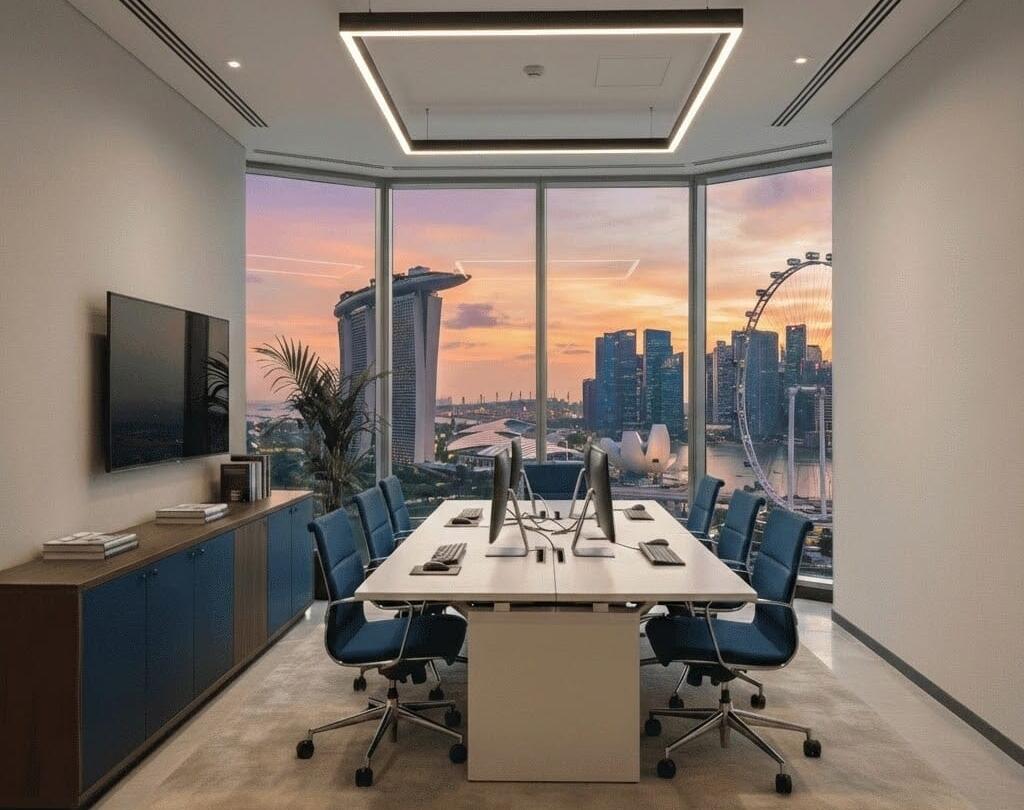
We estimate a private office in Singapore runs about SGD 780 a desk a month, aggregated from 1,934 quotes we have handled over the past year, not advertised rack rates. That figure is a blend across every office size; a small one or two person suite tends to cost more per desk, and it settles closer to that 780 once you are renting for three people or more. Search for a private office here and three names keep coming up: JustCo, Regus and Servcorp. Each has a genuinely different kind of space behind the name, and they suit different companies. As a free, independent Singapore office broker, Nextspace helps you search, view and negotiate across all three, at no cost, the operator pays us once you sign.
What a private office in Singapore actually costs
The market average
About SGD 780 a desk a month, blended across every office size, from 1,934 quotes we handled for Singapore companies over the past year across 50 operators.
One or two people
About SGD 1,500 a month in total. Our data does not split a single desk from a pair, so that lands between SGD 750 and 1,500 a desk depending on how many of the two you take.
Three desks and up
The per-desk cost eases down toward the SGD 780 average as the room gets bigger, which is where the blended figure comes from.
What the figure buys
Staffed reception in your company name, meeting-room credits, internet, utilities, cleaning, building management and an address you can register with ACRA.
Renting a private office in Singapore?
We compare JustCo, Regus, Servcorp and the independents, then negotiate for you. Free to you, the operator pays us on placement.
What the SGD 780 a desk actually includes
The per-desk figure buys more than a room. A typical private-office price at any of the three, and across the wider Singapore market, bundles in a staffed reception answering in your company name, meeting-room credits, fast internet and utilities, cleaning and building management, and a business address you can register with ACRA. Against a conventional lease you would pay separately for fit-out, furniture, a receptionist, IT, a management fee and a security deposit, usually on a two to three year commitment. The private-office model folds all of that into one monthly figure on a three to twelve month term, which is why it wins for most teams under about fifteen people even though the headline per-desk number looks higher than a raw rent per square foot. It also doubles as your ACRA registered address from day one, mail handling included, which a company incorporating in Singapore needs regardless of which operator it picks.
JustCo: the cheapest route into a private office
JustCo is a coworking-first operator, 10 or more locations across Singapore, strongest in the CBD (Robinson Road, Tanjong Pagar) and increasingly present further out. Its private offices sit inside its coworking floors, priced closer to the coworking end of the market than the CBD serviced-office rate, and available on shorter, more flexible terms, often three to six months rather than a year. It suits a small team that wants a lockable room now, without committing to a full serviced-office contract, and wants the option to add hot desks or a second room as headcount grows without moving buildings.
Regus: the fastest way into a specific district
Regus runs the widest private-office network in Singapore, 20 or more centres spread from the CBD to the fringe districts. If you need a district covered this month, on a standard contract you can sign without much back and forth, Regus is the name most likely to already have a location there. Coverage this wide comes with a real trade-off: quality varies more building to building than at a smaller, more curated operator, which is exactly where a broker who has actually seen the floors earns its keep.
Servcorp: the premium address and the service layer
Servcorp‘s centres sit in some of Singapore’s most recognised towers, paired with a reception and call-answering service that goes further than most competitors. It suits a client-facing team, a law firm, a fund, a regional headquarters, where the address itself is part of the pitch, and it prices at the top of the range accordingly. The service layer, a real person answering your line in your company name, is the part a cheaper option cannot replicate, and it is worth pricing separately from the desk if a virtual-office-style presence is genuinely what you need.
The three, side by side
| JustCo | Regus | Servcorp | |
|---|---|---|---|
| Best for | Lowest total cost to start | Fast coverage in a specific district | Client-facing teams, premium address |
| Singapore footprint | 10+ locations | 20+ centres, the widest network | Selective, prime addresses |
| Typical unit size | Smaller suites, inside a coworking floor | Standard private offices | Standard to larger private offices |
| Contract style | Short, flexible, scalable | Fast, standard | Higher-touch, service-led |
We don’t hold a big enough per-operator sample to say JustCo, Regus and Servcorp charge different rates for the same size room. Our SGD 780 figure above is a market-wide average, not a per-operator one. What genuinely differs is the size of the unit each one typically rents you: JustCo’s product starts smaller, a suite inside its coworking floor, which is why it usually ends up the lower total bill, not because the per-desk rate itself is lower.
How to choose, by what your team actually needs
Three questions settle it faster than comparing brand names. How many people, and how fast will that change? A one to three person team that expects to grow fits JustCo’s shorter, scalable terms; a settled team of five or more is better served by a standard Regus or Servcorp contract sized to fit now. Does a client walk into your office? If the address is part of how you win business, Servcorp’s tier or a comparable premium Regus building earns its price; if clients never see the space, that premium buys you nothing. How fast do you need to move? Regus’s 20 plus locations make it the fastest match to a specific district this month; JustCo and Servcorp both have gaps in coverage a broker can tell you about upfront, before you spend a day touring buildings that turn out not to have what you actually need.
What actually moves the price, beyond which operator you pick
Two things matter more day to day than which of the three names is on the door. The specific floor: the same operator runs a tired, half-full floor in one building and a sharp one two streets over, and the brand name alone won’t tell you which you’re being shown, only a viewing will. And the contract, which matters as much as the headline rate: notice period, deposit terms, included meeting-room hours, whether the desk count can flex without a full renegotiation. A slightly higher list price with a flexible contract regularly beats a cheaper one that locks you in for twelve months with no room to move if the team shrinks or a cheaper floor opens up two doors down.
Four things then move the actual rate you’re offered. Term length, a twelve-month commitment unlocks a better monthly price, sometimes a few free weeks, where a three-month deal costs more for the flexibility. Timing, an operator with empty rooms near quarter or year-end negotiates harder than one that’s nearly full. Inclusions, meeting-room credits, parking and a signage allowance are all tradeable, sometimes cheaper for the operator to give than a headline rent cut. And how you ask, a single company enquiring cold pays close to list price, while someone placing teams across the same buildings every month knows the current floor and negotiates against it, before the enquiry even reaches the operator’s sales team.
That last one is the actual mechanism, not a slogan. Nextspace holds live coverage across JustCo, Regus, Servcorp and the smaller independent operators none of them will mention, and because we place teams across the market every month rather than negotiating once, we typically know which specific floors in which buildings have room to move on rate this month.
Frequently asked questions
How much does a private office cost in Singapore?
About SGD 780 per desk a month, from 1,934 real quotes. See our serviced office price guide for the full breakdown by team size and district.
What is the cheapest way to get a private office in Singapore?
A JustCo-style private suite inside a coworking floor, from around SGD 1,500 a month for a small team, priced closer to the coworking market than the full CBD serviced-office rate.
What is the main difference between JustCo and Regus?
JustCo is coworking-first: its private offices sit inside shared floors, on shorter, more flexible terms, at the cheaper end of the market. Regus is serviced-office-first: private, furnished rooms as the default product, on the widest network of centres in Singapore.
Is Servcorp more expensive than Regus?
Servcorp generally sits at the premium end, in higher-tier buildings with a stronger reception and call-answering service, while Regus covers a wider range of price points across more locations and districts. Both price against the same market-wide aggregate above; the real gap narrows once terms are negotiated, especially on term length and timing.
Can I negotiate the rate at JustCo, Regus or Servcorp?
Yes. List prices are a starting point, not a fixed rate, and move with occupancy, desk count, term length and timing. A broker placing volume across the same buildings every month typically knows the current floor and gets a better outcome than a single company negotiating alone, cold, once.
Get real, negotiated private-office rates
Tell us your team size, district and budget. We compare JustCo, Regus, Servcorp and the independent operators, and send back real negotiated options within 24 hours. Free, the operator pays us on placement.
Related: Serviced office price in Singapore and our private office hub.